

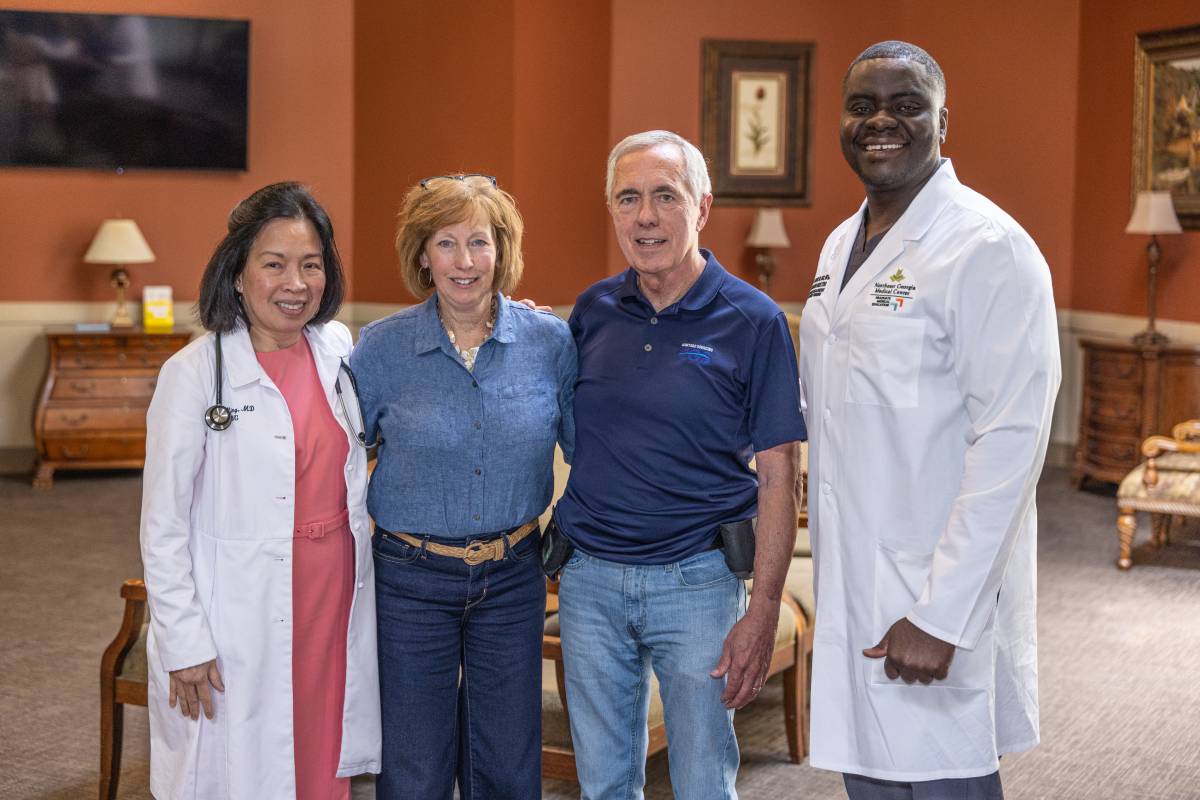
Mort Borland (second from right) is shown with Gainesville cardiologist Bernardine King, MD (from left), his wife, Lisa, and his heart failure cardiologist, Ugochukwu Egolum, MD, FACC, FHFSA, of Georgia Heart Institute.
Mort Borland has dealt with heart issues for most of his life. Thanks to the treatment he received from Georgia Heart Institute, he is feeling stronger than he has in years. He has just had to make a few changes to his old routine.
Now 73, Mort was born with a bicuspid aortic valve, meaning the valve that controls blood flow from the heart into the body’s largest artery has only two flaps instead of three. The defect was discovered when he was 14, and as an adult he had the valve replaced with a cow tissue valve.
In 2011, while waterskiing in Alabama, he experienced a life-threatening episode of ventricular tachycardia (VTAC), an abnormal rapid heart rhythm.
“I was unconscious, lying on my back in the water, and had turned blue”” said Mort.
He was airlifted from the remote lake to a local Hospital, where he was implanted with a defibrillator to shock his heart back into rhythm in case of emergency.
“It was touch and go,” he said. “I was in a coma for a while. It was the hand of God that got me through that.”
In October 2024, Mort felt short of breath. He was admitted to a hospital in Atlanta where he was diagnosed with congestive heart failure. His ejection fraction – a measure of how efficiently the heart pumps blood – was only 15% to 20%. A healthy person’s ejection fraction is typically 50% to 65%.
Mort’s cardiologist, Bernardine King, MD, referred him to Ugochukwu Egolum, MD, FACC, FHFSA, a heart failure cardiology specialist with Georgia Heart Institute, the comprehensive heart and vascular service line of Northeast Georgia Health System (NGHS). Dr. Egolum is the medical director of the left ventricular assist device (LVAD) program for NGHS. An LVAD is an implantable device that helps the heart pump. For some patients with advanced heart failure, it can give them back a remarkable quality of life.
Even though Mort had dealt with heart trouble for years, Dr. Egolum felt he wasn’t getting through to his new patient.
“He started talking to me about an LVAD,” said Mort. “After we had had a couple of appointments, he called my wife.”
“I basically said, ‘I think your husband is in denial,’” said Dr. Egolum. “Not denial that he has congestive heart failure, but rather how serious it is.”
“I had no doubt he was right” said Mort.
One night in late August 2025, Mort told his wife that he was extra tired and just wanted to lie down.
“My wife is smart enough not to ask me if I wanted her to call 911,” said Mort. “She just did it anyway.”
Mort was taken to Northeast Georgia Medical Center (NGMC) Gainesville. His blood pressure was “50-something over 40-something,” and he was beginning to have multiple organ failure.
“I saw him the next morning, and I said, ‘You know, your wife saved your life,’” said Dr Egolum. “’If she hadn’t gotten you in last night, you and I wouldn’t be having this conversation.’”
Mort agreed to undergo surgery a few days later to implant an LVAD, a procedure led by cardiothoracic surgeon Kyle Thompson, MD, surgical director of the NGHS LVAD program. As he recovered in the hospital over the next three weeks, Mort began feeling stronger.
“Once I got into walking, I could tell a difference,” he said. “The short-windedness was pretty much gone.”
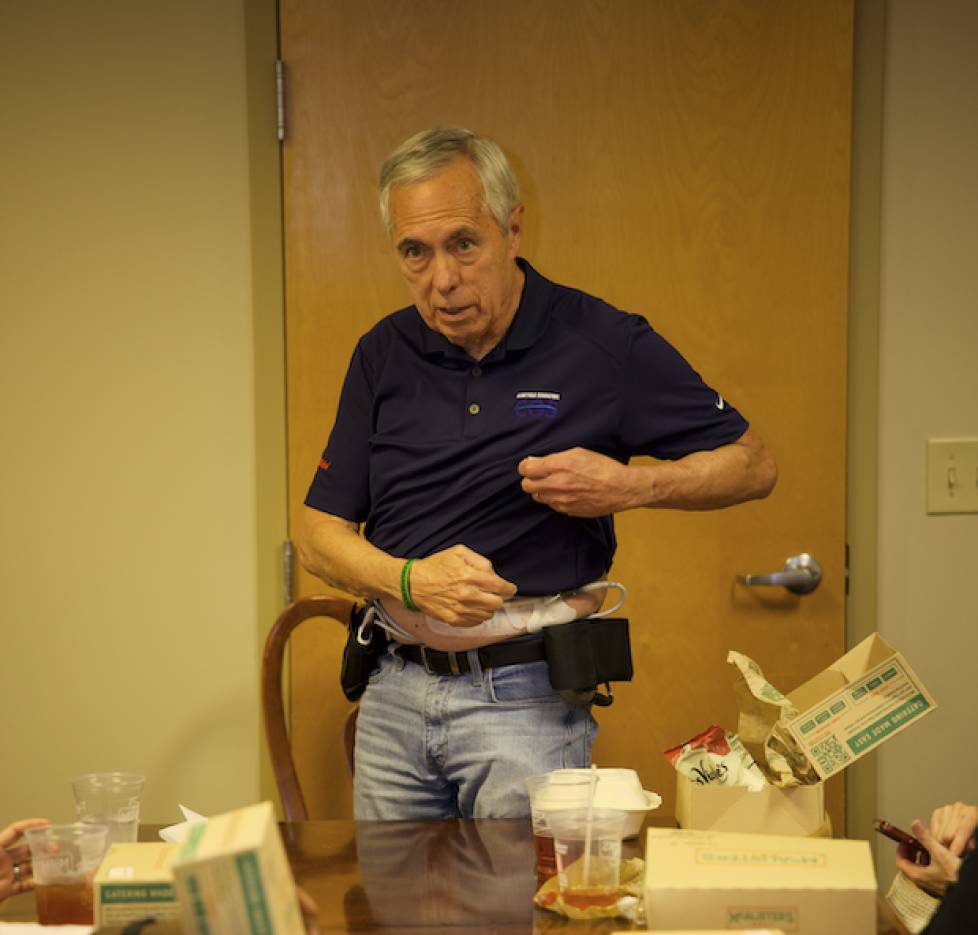
However, living with the device, and keeping up with its external power supply, took some getting used to.
“Initially, it is a definite change in lifestyle, but after a couple of months it becomes very routine.”
The LVAD program at NGHS is powered by a multidisciplinary team including RN VAD coordinators who are available 24/7 to help patients with issues ranging from how to change their surgical dressings to how to arrange for overseas travel.
“The LVAD team is very accessible and extremely responsive to my requests, questions, and concerns. Even for a prescription refill, I just tell them and they take care of it.”
And Mort has figured out a preferred way to carry his batteries. “I wear them on my belt almost like gun holsters.”
Mort has also been ramping up his activity level. He walks two miles four or five days a week. He also attends cardiac rehab, and he even drove for four hours to an out-of-town weekend with his friends from college.
Dr. Egolum said most LVAD patients can resume their favorite activities that they might have stopped doing due to illness.
“We have patients who love gardening, fishing and hunting, going on trips with family and grandchildren,” said Dr. Egolum. “We want them to get out there and enjoy the quality of life that they have regained.”
Mort praised the multidisciplinary team that has supported him through his surgery and ongoing recovery.
“The people connected with NGHS are just phenomenal,” he said. “The surgeon, Dr. Thompson, was terrific. The support team after him while I was in the hospital, not a weak spot in the lineup. I couldn’t have gotten a better support crew than at NGHS. I don’t have enough words to express how appreciative I am.”
For more information about the LVAD program, visit georgiaheartinstitute.org/lvad.