

Northeast Georgia Medical Center offers a comprehensive approach to stroke care, from early intervention treatments in the ER to inpatient and outpatient rehabilitation services helping patients regain function and independence.
Early Intervention
Early intervention for stroke patients is critical. There are treatments that can reduce the risk of damage from the most common type of stroke, but only if treatment is delivered within three hours of the onset of symptoms.
Know Your Risk!
Take this stroke risk assessment to determine your level of stroke risk.
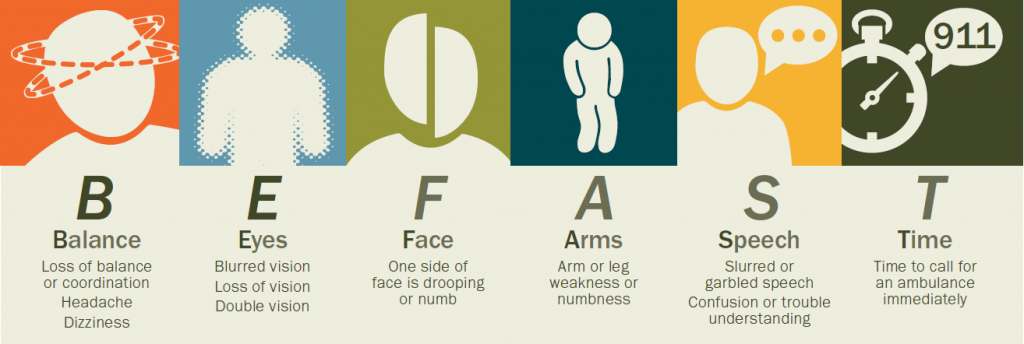
BE FAST
Call 911 immediately at any sign of a stroke. The acronym BE FAST helps you remember that when a stroke strikes, seconds count, and recognizing the sudden onset of any of the following symptoms can save someone’s life.
Efficiency in Care
NGMC’s ER utilizes numerous tools to provide high quality and efficient care to stroke patients.
- Our team follows the National Institute of Health’s Stroke Scale to evaluate stroke patients.
- We work to meet or exceed national benchmarks in “Door-to-CT” and “Door-to-Needle” times (the amount of time between when a stroke patient arrives in the ER and when they undergo a CT or receive tPA, lifesaving blood clot-busting medications).
- We work closely with EMS for pre-notification of a potential stroke victim during transport so staff is ready and waiting when the patient arrives.
Our expert care team includes:
- Nurses
- Physical therapists
- Occupational therapists
- Speech/language pathologists
- Registered dietitians
- Pharmacists
- Respiratory therapists
- Case managers
Why Choose NGMC?
Comprehensive Stroke Center
Northeast Georgia Medical Center (NGMC) Gainesville received the highest certification from DNV Healthcare as a Comprehensive Stroke Center in September 2021. This certification means our team can treat any variety of stroke-related events no matter the type or severity. NGMC Gainesville is the 6th hospital in the state to achieve this milestone.
Primary Stroke Center
Prior to becoming a Comprehensive Stroke Center, NGMC Gainesville was certified as a Primary Stroke Center in 2010, demonstrating our commitment to excellence in stroke care. It was the first hospital in the state of Georgia to gain this accreditation from DNV Healthcare. NGMC Habersham has been accredited as a Primary Stroke Center since 2006. In 2020, NGMC Barrow and NGMC Braselton were also accredited as Primary Stroke Centers.
CARF Stroke Specialty Certified
NGMC’s inpatient rehabilitation unit was one of the first 20 in the nation to receive Stroke Specialty Certification from the Commission on Accreditation of Rehabilitation Facilities (CARF).
NGMC Gainesville has received the following recognitions for its commitment and success in implementing a higher standard of stroke care:
NGMC Braselton has received the following recognitions for its commitment to advancing stroke care:
NGMC Barrow has received the following recognition for its commitment to advancing stroke care:
NGMC Habersham has received the following recognition for its commitment to advancing stroke care:
- Primary Stroke Center Accreditation by DNV Healthcare
- Get With The Guidelines – Gold Plus Target Stroke Honor Roll Elite
- Circle of Excellence – Hospital Consumer Assessment of Healthcare Providers and Systems (HCAHPS)